
Picture this: You’re sitting in a meeting, discussing your company’s latest performance. The sales figures are on board, but they’re outdated, static, and don’t reflect the current market chaos. Your marketing team is presenting metrics from last quarter, and your customer service reports are stuck in a time warp. You’ve all seen the trends of slow growth, missed opportunities, and frustration among teams who feel they lack the insights to act decisively.
Now imagine this: You have a tool at your fingertips that could turn this entire scenario into its head. A tool that offers real-time insights, predictive analytics, and tailored reports that can help you spot trends before they happen. Your sales team is suddenly closing deals faster, your customer service department is more efficient than ever, and your marketing is laser-focused on the most promising leads. You’ve just tapped into the power of CRM Analytics, but that’s only half of the story. Without Managed Support, you might still find yourself drifting in the sea of data without a compass.
In this blog post, we’ll uncover how CRM Analytics and Managed Support aren’t just game changers. They’re the difference between staying ahead of the competition and getting lost in a flood of data. We’ll show you why your Salesforce reporting might be at risk and how these tools can save you from the nightmare of poor decision-making and missed opportunities. Ready for the journey? Let’s dive in.
Understanding Salesforce Reporting
- Salesforce reporting enables the generation of insights from available data for any enterprise, helping stakeholders make informed decisions and take practical actions.
- Reports include the customer’s interactions, sales activities, marketing campaigns, and much more.
- However, they have typically been confined within the boundaries of static, historical data limitations and the significant amount of manual work required for report generation, which hinders meaningful insight, making it almost impossible.
- That’s where CRM Analytics comes in.
What are CRM Analytics?
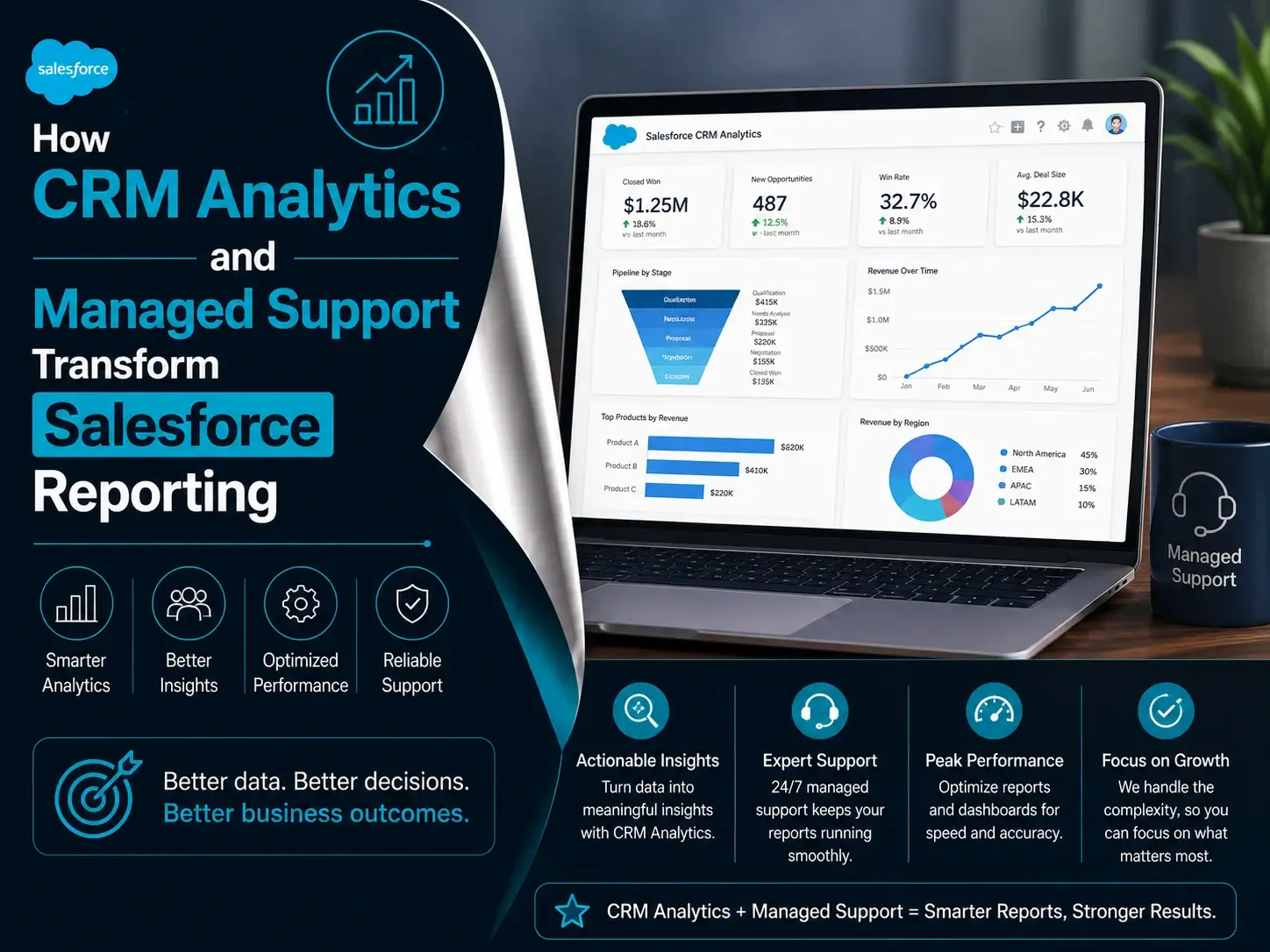
- CRM Analytics is the world’s most sophisticated integrated analytics solution for Salesforce CRM.
- Moreover, this is not basic reporting because it features an additional advanced feature, artificial intelligence (AI), for providing appraised insights, predictive analytics, and a customizable dashboard.
- Users can dynamically go beyond using CRM Analytics for report-based drill-down measures to uncover trends that are rarely visible through standard reports.
- Under the guidance of AI capabilities, recommendations can be provided on the best actions to take based on real-time data, which is one of the most substantial advantages in sales, customer service, and marketing operations.
- And all of this is tied up completely within your Salesforce environment, so no decision is made without data from inside your system.
Key Benefits of CRM Analytics
– Informed Decisions with Data-Driven Insights:
Use CRM data to equip teams with actionable insights from a big data pool. For instance, sales teams can predict which leads tend to convert more effectively or identify the product features customers want, and they can make informed, proactive decisions.
– Customization and Individualization
The metrics relevant to them can be included in tailor-made dashboards and reports. For example, engagement metrics may be a priority for a marketing team, whereas pipeline data may be more relevant to a sales team. CRM Analytics provides the flexibility to design reports tailored to individual roles and business needs.
– Predictive Insights and AI
CRM analytics provide real-time analytical capabilities, predictive scoring applications, and other metrics that enable predictions of future sales trends, high-risk customers, or optimal strategies, allowing businesses to visualize challenges well in advance and capitalize on opportunities immediately.
– Real-Time Access to Information
CRM Analytics provides real-time data processing, ensuring that users access the most current data at any point in time. Whether it is sales performance or customer satisfaction, real-time access enables businesses to respond more quickly to changing market dynamics.
Managed Support: A Strategic Approach to Salesforce Reporting
While CRM Analytics provides extensive tools for data analysis, Managed Support services enable organizations to maximize the use of these tools. Managed Support refers to the proactive, strategic management of Salesforce systems by expert teams.

This ranges from ongoing maintenance and troubleshooting to advanced customization and optimization of Salesforce features such as CRM Analytics.
How Managed Support Enhances Salesforce Reporting:
– Customization and Integration
The Salesforce is very customizable. However, most organizations require expert guidance to implement advanced features such as CRM Analytics. Managed Support ensures the proper integration of these tools into Salesforce’s existing workflows, dashboards, and reports in a way that allows users not only to create reports but also to create reports that matter in achieving their specific business objectives.
– Continuous Improvements
With managed support, users also benefit from ongoing system optimizations from Salesforce. As the business environment changes, the support team will ensure that reports and analytics align with new KPIs or strategic goals; hence, the insights will become even more accurate, relevant, and actionable over time.
– User Training and Adoption
Even with an excellent analysis tool like CRM Analytics, the fact remains that many organizations will never achieve effective adoption of their respective systems by their users.




Managed support teams can provide training to educate users at all levels on the maximally effective use of these systems. Best practices for impactful report creation, trend analysis, and predictions can also be included.
– Quick Issue Fixes
If a user encounters any technical issues with their Salesforce reports or analytics, Managed Support provides fast troubleshooting and resolution. This ensures that teams are not hindered in making data-driven decisions due to being bogged down by technical issues.
The Synergy Between CRM Analytics and Managed Support
- With Managed Support alongside CRM Analytics, organizations are introduced to a comprehensive solution for generating insights, ensuring accessibility, accuracy, and continuous refinement of insights generated through analytics.
- For example, the support team can help recalibrate CRM Analytics based on changing company needs, such as refining predictive models or introducing alternative data sources. This synergy has elevated the game of continuous reporting enhancement based on analytics, making it easier and more efficient for business operations.
Bottom line
If an organization wants to enhance its Salesforce reporting, then CRM Analytics and Managed Support are required components. With CRM Analytics, organizations can gain advanced AI-enabled insights, predictive analytics, and real-time data infused into reports, enabling transformative experiences as businesses start to understand and act on their data.
Managed support, therefore, allows companies to maintain, customize, and optimize these tools, thereby increasing the pace of value creation and continuous improvement through Salesforce. Purchasing and utilizing CRM Analytics and Managed Support will no longer be part of the decision-making process for companies that hope to remain at the forefront in today’s fast-paced market.
Complete utilization of Salesforce reporting grants the power to make more intelligent and informed decisions, enhances productivity, and gives a competitive edge in the industry.
Don’t forget to share your thoughts in the comment section below and check out more articles on our website aDigital Lamp now!